
Local SEO
Local SEO: how to show up when people search for services in your city
Showing up on Google when someone searches for a service in your city does not depend only on having a website. It depends on clear, consistent and measurable local signals.
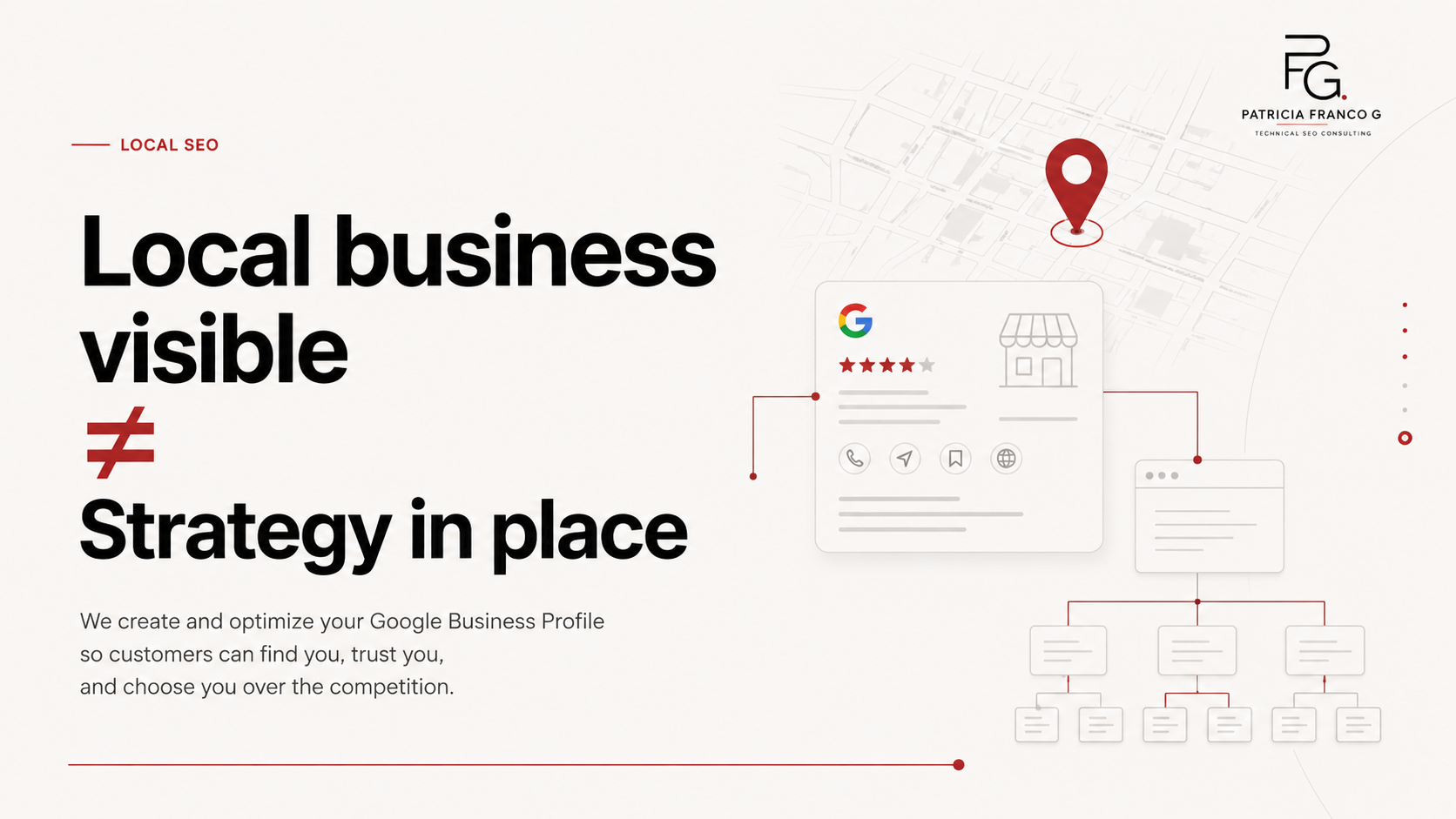
Showing up on Google when someone searches for a service in your city does not depend only on having a website.
It depends on whether Google can understand where your business operates, what services you offer, which areas you serve, how trustworthy you are and whether your digital presence matches the intent of a local customer.
Local SEO is not about repeating the city name over and over.
It is about building clear signals so Google can connect your business with searches like:
dentist in Austin
immigration attorney in Miami
pool cleaning in Weston
SEO consultant in Dallas
med spa near me
When someone makes this type of search, they are not browsing casually. They have a specific need, a location and often a strong commercial intent.
The problem is that many companies have a published website, but they do not have a local structure built to compete.
Their Google Business Profile is incomplete, their pages lack geographic intent, their services are poorly defined, their reviews are limited, their signals are inconsistent and their site architecture does not help Google understand them as a relevant option in their area.
In this guide, I explain what a local SEO strategy needs so your business can stop relying only on ads, referrals or social media and start capturing organic demand in your market.
If you want to review your specific case, you can request a Strategic SEO Audit to identify what is holding back your local visibility.
1. What local SEO really is
Local SEO is the strategic and technical work that helps a business appear on Google when someone searches for products or services in a specific area.
It is not only about showing up on Google Maps.
It is not only about having a Google Business Profile.
And it is not only about adding a city name to a page title.
Local SEO combines multiple signals:
- Google Business Profile.
- Website structure.
- Service pages.
- City or service-area pages.
- Reviews.
- Data consistency.
- Local links.
- Structured data.
- Useful content.
- Business authority.
- Geographic signals.
Google needs to understand three things:
- What you do.
- Where you do it.
- Why it should show you instead of other businesses in the area.
If those signals are incomplete or disorganized, your business may exist online and still remain invisible for the local searches that could generate calls, forms and customers.
2. How Google decides which businesses to show in local searches
Google explains that local results are primarily based on three factors: relevance, distance and prominence. Relevance measures how well your business matches what the person is searching for. Distance considers how close you are to the location used in the search. Prominence evaluates how well known or trustworthy your business appears to be.
This matters because many companies assume local SEO depends only on proximity.
It does not.
You can be close to the customer and still not appear if Google does not understand your services, if your profile is incomplete, if your website lacks relevant pages or if your trust signals are weak.
Relevance
Google needs to know whether your business actually offers what the person is looking for.
For example, if someone searches for “SEO audit in Miami,” Google needs clear signals that your business offers SEO audits, not just generic “digital marketing.”
Distance
Google evaluates the user’s location, the city mentioned in the search or the service area listed in your profile.
That is why your physical location or service areas must be configured correctly.
Prominence
Google also considers reputation, visibility and authority signals.
This includes reviews, mentions, links, profile activity, data consistency and the overall strength of your brand.
3. Google Business Profile: the visible foundation of local SEO
Google Business Profile is one of the most important pieces of local SEO.
It is the profile that can appear on Google Search and Google Maps with your business name, category, reviews, hours, services, photos, location, phone number, website and contact buttons.
Google recommends keeping profile information complete and accurate because businesses with full, precise information have a better chance of appearing for relevant local searches.
But having a profile does not mean it is properly optimized.
A weak profile usually has problems like:
- The primary category is wrong.
- Services are incomplete.
- The description is generic.
- There are very few photos.
- There are no posts or updates.
- Business hours are incorrect.
- Service areas are missing.
- Reviews are not answered.
- The website is disconnected from the local strategy.
- The business name is inconsistent.
What an optimized profile should include
Your Google Business Profile should clearly explain:
- What type of business you are.
- What services you offer.
- Which city or area you serve.
- How people can contact you.
- What your business hours are.
- What makes you different.
- What clients say about you.
- Which website supports that information.
This is not about filling out fields just to fill them out.
It is about building a profile Google can interpret and a potential customer can trust.
4. Why your website also matters for local rankings
Many businesses believe local SEO lives only inside Google Maps.
That is one of the most expensive mistakes.
Google Business Profile matters, but your website is still a critical foundation for explaining services, locations, authority and conversion.
Your website should support what your profile says.
If your profile says you offer “local SEO,” but your website does not have a clear local SEO page, Google receives an incomplete signal.
If your profile says you serve several cities, but your website has no city or service-area structure, Google may have less clarity about your real coverage.
If your site only has one generic services page, it is harder to compete against businesses with specific pages for each service and intent.
What your website should include
A strong local structure can include:
- A clear homepage.
- A main services page.
- Specific pages for each service.
- City or service-area pages when they make sense.
- Local frequently asked questions.
- Consistent contact information.
- Internal links to main service pages.
- Local Business schema.
- Useful content connected to local searches.
Your website should not be just a digital business card.
It should work as infrastructure that helps Google understand, classify and recommend your business.
5. Service and city pages: the mistake many businesses do not fix
One of the most common mistakes in local SEO is trying to rank everything with one page.
For example:
Services
Inside that page, every service, location, solution and audience gets mixed together.
That creates confusion.
Google needs specific URLs to better understand which service you want to rank for and in what local context.
Weak example
/services
On that page, you mention SEO audits, local SEO, technical SEO, content, Google Business Profile and reporting.
More strategic example
/local-seo
/seo-audit
/technical-seo
/google-business-profile
/local-seo-miami
Not every business needs dozens of local pages. But when a business serves multiple cities, areas or services with specific demand, a more granular structure can help significantly.
Be careful with this
Do not create city pages if they are almost identical copies.
That creates weak content.
Each local page should provide useful, distinct information connected to a real intent:
- The service offered.
- The city or service area.
- Common local customer problems.
- The process.
- Frequently asked questions.
- Trust signals.
- A clear CTA.
- Internal links.
The goal is not to create more URLs.
The goal is to build pages that have a real reason to exist.
6. Reviews, trust and local authority signals
Reviews are important for users and they are also part of a business’s local presence.
But this is not only about collecting stars.
A serious review strategy should focus on:
- Real reviews.
- Specific comments.
- Professional responses.
- Consistent frequency.
- Natural language related to the service.
- Visible trust for new customers.
A review that says “excellent service” helps less than a review that explains what service the person received, in what city, what problem they had and how they were helped.
Example of a stronger review
“I booked the SEO audit because my website was not showing up on Google in Miami. Patricia reviewed Search Console, sitemap, blocked pages and site structure. She gave me clear priorities and an action plan.”
That review adds context.
Google and potential customers can better understand what you do and why someone trusted you.
What to do
After every satisfied client, ask for a specific review.
Do not force keywords.
Do not invent testimonials.
Do not buy reviews.
Build real trust and respond to every comment professionally.
7. Data consistency: name, address and phone
Local SEO also depends on consistency.
Your business name, phone number, address, website and contact details should match across the important places where your business appears.
This includes:
- Google Business Profile.
- Your website.
- Social media profiles.
- Local directories.
- Business associations.
- Review platforms.
- Contact pages.
- Your website footer.
If one place shows one business name, another shows a different phone number and another shows a different address, Google may receive confusing signals.
What to check
Confirm that these details are consistent:
- Business name.
- Address or service area.
- Phone number.
- Email.
- Website.
- Business hours.
- Business category.
- Main services.
Consistency alone does not guarantee rankings.
But inconsistency can weaken trust.
8. Structured data for local businesses
Structured data helps Google better interpret the information on a page.
For local businesses, Google allows Local Business markup to communicate information such as hours, departments, reviews and business details.
This does not replace content and it does not guarantee rankings.
But it can help Google understand what type of business you are, what services you offer and how your website connects to your business entity.
What data can be marked up
Depending on the type of business, you can work with:
- LocalBusiness.
- Organization.
- Service.
- FAQPage.
- Article.
- BreadcrumbList.
- PostalAddress.
- OpeningHours.
- AggregateRating, when applicable and compliant.
Google also explains that structured data helps it understand page content and certain entities present on the page.
Important
Do not add false structured data.
Do not mark up reviews that do not exist.
Do not use schema as technical makeup.
Schema should reinforce a reality that already exists on the page.
9. Common mistakes that hold local SEO back
Local SEO fails when it is treated as an isolated task instead of a system.
These are the mistakes I see most often:
- Building a nice-looking website without local structure.
- Having an incomplete Google Business Profile.
- Choosing the wrong primary category.
- Not adding services.
- Not responding to reviews.
- Not building pages by service.
- Repeating the city name unnaturally.
- Creating duplicate local pages.
- Not showing contact information clearly.
- Not using internal links.
- Not measuring calls, forms or clicks.
- Not reviewing Search Console.
- Not implementing structured data.
- Depending only on paid ads.
- Not having a monthly improvement strategy.
The problem is not always that the market is too competitive.
Many times, the problem is that your business is not sending clear signals.
10. Local SEO diagnostic checklist
Before investing more in ads or redesigning your website again, review this:
- Your Google Business Profile is verified.
- The primary category is correct.
- Services are complete.
- The description clearly communicates what you do.
- Service areas are configured correctly.
- Business hours are updated.
- The website is linked correctly.
- There are real photos of the business or service.
- Reviews are being answered.
- Your website has specific service pages.
- Your website clearly mentions city or service-area coverage.
- The contact page has consistent information.
- The footer includes basic business information.
- There are internal links to main services.
- There are FAQs related to local questions.
- The sitemap works.
- Search Console does not show serious blocks.
- Structured data is implemented when appropriate.
- Calls, forms and organic clicks are being measured.
If several of these are missing, you do not need “more posts.”
You need a diagnosis.
Visual checklist: Google Business Profile, services, reviews, city pages, NAP, schema, Search Console, calls and forms.
11. Frequently asked questions
Is local SEO the same as Google Maps?
No.
Google Maps is an important part of local SEO, but it is not the whole system.
Local SEO also includes your website, service pages, content, reviews, structured data, internal links, geographic signals and business consistency across the web.
Do I need one page for every city?
It depends.
If you serve multiple cities and there is real demand in each one, local pages may make sense.
But they should not be identical copies with only the city name changed.
Each page needs useful content, local context, FAQs, clear services and a real reason to exist.
Do reviews help local SEO?
Yes. Reviews help build trust and local prominence.
But they should be real, consistent and specific.
It is not only about having many stars. It is about showing that the business exists, serves real customers and earns trust.
How long does local SEO take to work?
It depends on the current state of the business, the competition, website quality, Google Business Profile quality, reviews and signal consistency.
In some cases, early improvements can appear within weeks. In more competitive markets, building a strong foundation can take several months.
Can I do local SEO without a website?
You can have visibility through Google Business Profile, but working without a website limits your ability to explain services, build specific pages, create authority and turn searches into forms or calls.
A profile helps.
A well-structured website supports the entire system.
Conclusion
Local SEO is not about appearing everywhere.
It is about being found when someone is already searching for a service in your city.
To make that happen, Google needs clear signals: a complete Google Business Profile, a well-structured website, service pages, locally relevant content, real reviews, consistent data and a technical foundation that allows the system to be measured and improved.
A local business does not need to be everywhere.
It needs to appear in the right searches, in front of the right people, at the right moment.
That is when local SEO stops being a marketing task and becomes organic acquisition infrastructure.
Is your business invisible when people search for services in your city?
Request a Strategic SEO Audit and receive a clear diagnosis of your Google Business Profile, local pages, website structure, reviews, technical data and organic growth opportunities.
Request an SEO AuditWho wrote this diagnostic guide
Patricia Franco G. is a consultant specializing in Technical SEO, site architecture and organic growth for service-based businesses.
She works directly on every audit, strategy and implementation. Her approach focuses on identifying what is holding back a website’s visibility, prioritizing the right fixes and building a structure capable of attracting traffic, forms, calls and real business opportunities.