
SEO Audit
SEO Audit: what a professional diagnostic should include
A professional SEO audit is not an automated list of errors. It should explain what is holding back your visibility, what needs to be fixed first and how to turn the diagnostic into measurable organic growth.
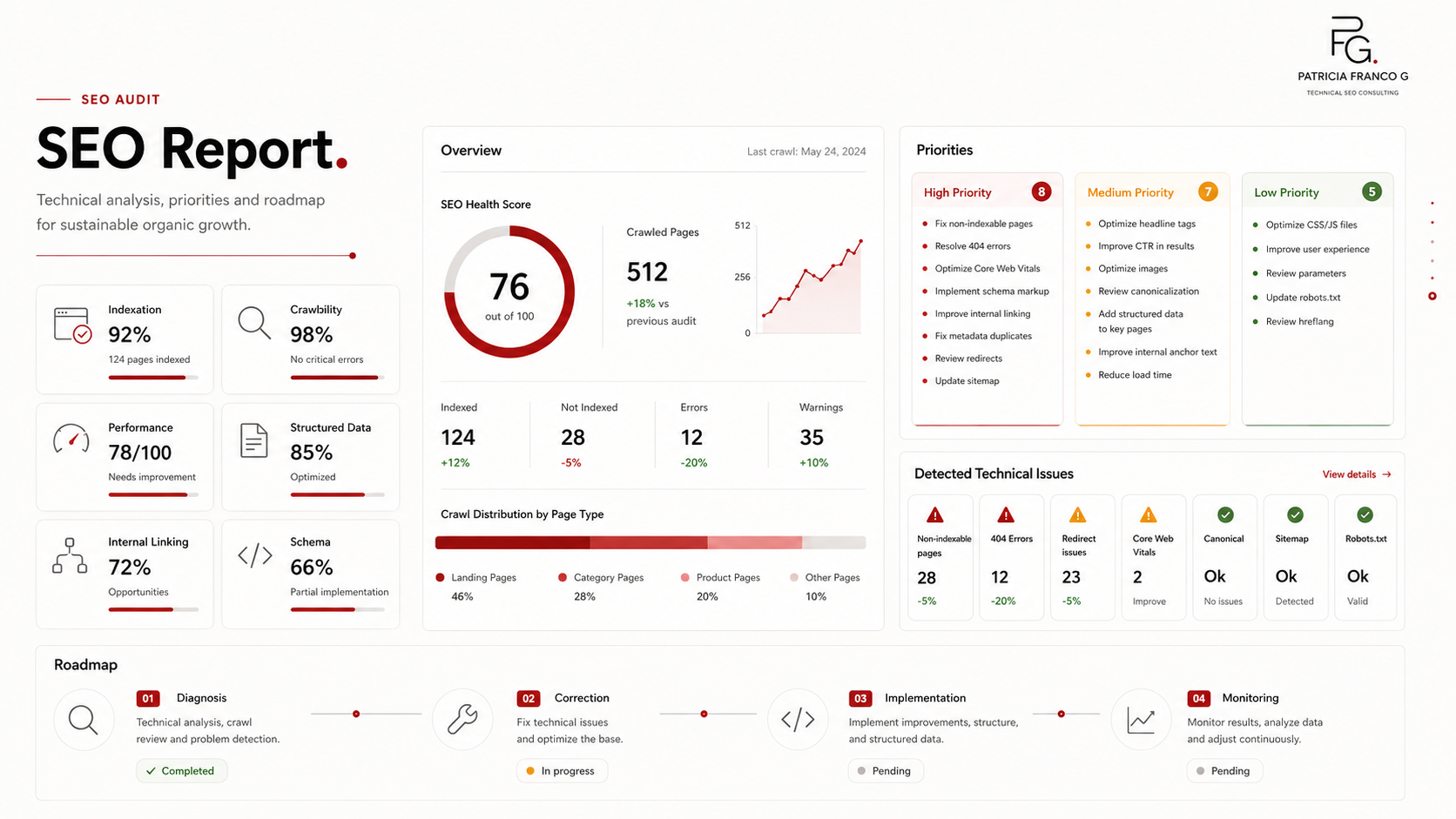
A professional SEO audit is not an automated list of errors.
It is not a quick review of titles, keywords and page speed either.
A serious SEO audit should explain what is holding back a website's visibility, which issues have the highest impact, what should be fixed first and how to turn that information into a real organic growth plan.
The problem is that many businesses receive reports full of data, charts and technical alerts, but leave just as confused as they were before.
They know something is wrong.
But they do not know what it means, how serious it is, what to prioritize or how it connects to traffic, forms, calls or sales.
A professional SEO audit should not leave you with more questions.
It should give you clarity.
In this guide, I explain what a real SEO diagnostic should include, how to tell the difference between a superficial review and a strategic audit, and what deliverables you should receive before investing in monthly SEO.
If you want to review your website directly, you can request a Strategic SEO Audit and receive a clear diagnostic of what is holding back your visibility.
1. What a professional SEO audit is
A professional SEO audit is a complete diagnostic of a website's organic condition.
Its goal is not only to find errors.
Its goal is to understand why a website is not generating the visibility it should and which actions can improve its ability to be crawled, indexed, understood, ranked and chosen.
An SEO audit should review the website as a system:
- Crawling.
- Indexation.
- Architecture.
- Content.
- Search intent.
- On-page SEO.
- Speed.
- Mobile experience.
- Local SEO.
- Structured data.
- Internal linking.
- Authority.
- Conversion.
- Measurement.
A professional audit connects technical problems with business decisions.
It is not enough to say:
"There are 404 errors."
The audit should explain:
- Which URLs have the issue.
- Why it affects the website.
- How urgent it is.
- How it should be fixed.
- What impact it may have on visibility, experience or conversion.
The value is not in finding errors.
The value is in knowing which errors matter and what to do with them.
2. What an SEO audit should not be
An SEO audit should not be an automatic PDF exported from a tool.
Tools help.
But they do not replace technical judgment.
A tool can detect issues, but it does not always understand business context, search intent, the commercial priority of each page or the real impact of a specific fix.
A superficial audit usually looks like this:
- A long list of errors without explanation.
- Tool screenshots without interpretation.
- Generic recommendations.
- Problems with no priority.
- No roadmap.
- No connection to leads, calls or forms.
- No review of search intent.
- No strategic reading of the website.
- No clear implementation proposal.
That is not a diagnostic.
It is noise.
A professional audit should help you make decisions.
Not just collect tasks.
3. Why an audit is the first step before monthly SEO
Doing monthly SEO without an audit is like building on a foundation you have not inspected.
You can publish articles, change titles, create pages or invest in backlinks, but if the site has indexation problems, weak architecture, slow performance, canonical issues, duplicate content or blocked pages, growth will be limited.
Before execution, there must be understanding.
First, diagnose.
Then prioritize.
Then implement.
Then measure.
That order reduces risk, avoids unnecessary work and focuses resources on the actions that can actually move organic visibility.
Simple example
If a website does not appear on Google because important pages are set to noindex, it does not make sense to start by creating 10 new articles.
Indexation must be fixed first.
If a website mixes every service into one generic page, it does not make sense to only optimize the meta description.
Architecture must be reviewed first.
If a website gets visits but does not generate contacts, rankings are not the only issue.
Conversion must be reviewed too.
An SEO audit exists to organize the work.
Not to decorate a report.
Diagnostic -> Priority -> Roadmap -> Implementation -> Measurement
That is the logical order of a professional SEO audit.
4. Crawling and indexation review
The first question in an SEO audit is simple:
Can Google find, crawl and index the important pages?
If the answer is no, everything else is limited.
A professional review should analyze:
- Robots.txt.
- XML sitemap.
- Indexed URLs.
- Excluded URLs.
- Blocked pages.
- Orphan pages.
- 404 errors.
- Redirects.
- Canonical tags.
- Click depth.
- Google Search Console coverage.
- Crawled but not indexed pages.
- Discovered but not crawled pages.
This is where many invisible issues are found.
The site may look normal to users, while sending confusing signals to Google.
What this part of the audit should answer
- Which pages are indexed.
- Which pages should be indexed but are not.
- Which pages are indexed but should not be.
- Which URLs are blocked.
- Which errors prevent crawling.
- Which important pages are buried too deep.
- Which URLs receive no internal links.
If Google cannot read your pages, it cannot rank them.
5. Site architecture analysis
Site architecture defines how the website is organized.
It is not just design.
It is structure.
A professional SEO audit should review whether the website is built around services, categories, locations, search intent and conversion paths.
Weak architecture usually creates problems like:
- An unclear menu.
- Services mixed together.
- Important pages hidden.
- A blog disconnected from service pages.
- Missing pages for commercial intent.
- Weak internal linking.
- Orphan pages.
- Excessive click depth.
- URLs without hierarchy.
- Duplicate or overlapping content.
What should be analyzed
A good audit should answer:
- Which pages should exist.
- Which pages are unnecessary.
- Which pages should be merged.
- Which pages need more content.
- Which pages should link to each other.
- Which services need their own URL.
- Which informational content can support commercial pages.
Site architecture matters because Google needs to understand the relationship between your pages.
And users need to reach what they are looking for quickly.
6. On-page SEO audit
On-page SEO reviews how each individual page is optimized.
It is not only about adding keywords.
It is about verifying whether each URL has a clear purpose inside the system.
An on-page audit should review:
- Title tags.
- Meta descriptions.
- H1 headings.
- H2 and H3 structure.
- URL structure.
- Internal links.
- Image alt text.
- Duplicate titles.
- Thin content.
- Keyword cannibalization.
- Search intent alignment.
- Calls to action.
A page can have an "optimized" title and still fail to do its job.
For example:
"High-quality professional services"
That does not tell Google or the user much.
A page needs to communicate clearly:
- What service it offers.
- Who it is for.
- What problem it solves.
- Which location it applies to, if local.
- What the user should do next.
On-page SEO is not cosmetic.
It is strategic clarity applied to each URL.
7. Content and search intent review
A professional SEO audit should review whether the content answers real searches.
Not every text has SEO value.
A page can have many words and still fail to answer a clear intent.
Search intent can be:
- Informational.
- Commercial.
- Local.
- Transactional.
- Comparative.
- Branded.
A strong website needs content for multiple stages.
But every page should have a purpose.
What the audit should review
- Whether the content answers a real question.
- Whether commercial pages explain the service clearly.
- Whether there is duplicate content.
- Whether important service pages are missing.
- Whether the blog supports site authority.
- Whether topic clusters exist.
- Whether each URL has one main intent.
- Whether content leads toward conversion.
Example
An article like:
"Why your website does not show up on Google"
can attract users with a clear technical problem.
From there, the website can link to an SEO audit.
That turns the blog into a strategic library, not a collection of disconnected posts.
8. Speed, mobile experience and Core Web Vitals
Speed is not just a technical metric.
It affects user experience and can influence organic performance.
An SEO audit should review how the site loads, especially on mobile.
The most common issues are:
- Images that are too heavy.
- Unnecessary scripts.
- Bloated templates.
- Excessive animations.
- Poorly loaded fonts.
- Slow server response.
- Elements that shift while loading.
- Heavy visual blocks.
- Poor mobile experience.
What this review should include
- Mobile performance.
- Core Web Vitals.
- Initial load time.
- Image weight.
- Visual stability.
- Render-blocking resources.
- Experience on key pages.
- Prioritized recommendations.
Not every technical fix has the same impact.
A professional audit should not simply say "improve speed."
It should explain what is slowing down the website, where it happens and what should be fixed first.
9. Local SEO and Google Business Profile
If the business depends on a city, region or service area, the audit should also review local SEO.
This applies to:
- Clinics.
- Law firms.
- Consultants.
- Service businesses.
- Local businesses.
- Restaurants.
- Construction companies.
- Maintenance services.
- Independent professionals.
- Businesses with multiple locations.
A local audit should review:
- Google Business Profile.
- Primary category.
- Secondary categories.
- Services.
- Reviews.
- Review responses.
- Photos.
- Business hours.
- Service areas.
- NAP consistency.
- City or service-area pages.
- Local signals on the website.
- Local schema.
- Local competition.
What this part of the diagnostic looks for
It looks for whether Google can associate your company with a location, a service and a local commercial intent.
It is not enough to say "we work in the United States" or "we serve Miami."
The structure must support it.
10. Structured data and entity signals
Structured data helps Google better interpret certain elements on a page.
It is not magic.
It does not guarantee rankings.
But when implemented correctly, it can reinforce Google’s understanding of the site.
An SEO audit should review whether structured data exists and whether it is applied correctly.
Useful types may include:
- Organization.
- LocalBusiness.
- Service.
- Article.
- FAQPage.
- BreadcrumbList.
- WebSite.
- Person.
What the audit should review
- Whether schema exists.
- Whether it validates correctly.
- Whether it matches the real content.
- Whether there are errors.
- Whether false or unnecessary data is being used.
- Whether it helps identify the business, services, articles and main entities.
Schema should not be used as technical decoration.
It should reinforce something that already exists on the page.
11. Keyword research and commercial opportunities
An SEO audit should not be limited to finding errors.
It should also identify opportunities.
Keyword research helps reveal what customers are searching for and how the site should be organized to capture that demand.
But not every keyword is useful.
A search with high volume may not generate customers.
A search with lower volume but strong commercial intent may be more valuable.
What this part should include
- Commercial keywords.
- Local keywords.
- Informational keywords.
- Service-based searches.
- City-based searches.
- Frequently asked questions.
- Content opportunities.
- Keywords already generating impressions.
- Keywords close to page-one rankings.
- Competitor gaps.
Example
For a service business, opportunities may include:
- "SEO audit"
- "technical SEO consultant"
- "local SEO for businesses"
- "why my website does not show up on Google"
- "Google Business Profile optimization"
- "SEO service in [city]"
The audit should translate those searches into pages, content and priorities.
Not just a list of words.
12. Strategic implementation roadmap
The roadmap is one of the most important parts of a professional SEO audit.
Without a roadmap, the audit stays as a diagnostic.
With a roadmap, it becomes an action plan.
The roadmap should organize what must be fixed first, what can wait and what actions belong in a monthly strategy.
What it should include
- Priority for each action.
- Impact level.
- Difficulty level.
- Recommended owner.
- Implementation phase.
- Connection to business goals.
- Technical actions.
- Content actions.
- Local actions.
- Measurement actions.
- Next steps.
Example phases
Phase 1: Critical fixes
Indexation, sitemap, robots.txt, noindex, 404 errors, canonical tags, Search Console.
Phase 2: Architecture and key pages
Services, structure, internal links, commercial pages and conversion paths.
Phase 3: Content and semantic expansion
Articles, clusters, intent-based pages, FAQs and local content.
Phase 4: Measurement and monthly optimization
CTR, rankings, forms, calls, growing pages and new opportunities.
A roadmap helps you stop working by intuition.
And start working by priority.
13. What deliverables an SEO audit should include
A professional SEO audit should deliver more than observations.
It should deliver clarity.
Deliverables may vary depending on the project, but a serious audit should include at least:
1. Technical report
A document with findings, issue explanations, screenshots, affected URLs, priority and recommendations.
2. Prioritized list of fixes
Not every task carries the same weight.
The audit should separate critical, important and secondary actions.
3. Initial keyword research
A search map organized by service, city, intent or category.
4. Architecture review
Analysis of the current structure and recommendations for pages, hierarchy and internal linking.
5. SEO roadmap
A phased work plan.
Ideally, with a 90-day view and a 12-month growth direction.
6. Strategic meeting
A professional audit should be explainable.
The meeting helps clarify findings, recommended decisions and next steps.
7. Implementation proposal
After the diagnostic, it should be clear what can be implemented, in what order and with what objective.
An audit that does not lead to decisions is incomplete.
14. Common mistakes in superficial audits
Not every audit helps you make decisions.
These are common mistakes:
- Delivering only an automated PDF.
- Not explaining priorities.
- Not reviewing Search Console.
- Not analyzing indexation.
- Not reviewing architecture.
- Not evaluating search intent.
- Not reviewing commercial pages.
- Not connecting the blog with services.
- Not reviewing conversion.
- Not reviewing local SEO.
- Not reviewing structured data.
- Not including a roadmap.
- Not explaining impact.
- Not separating urgent issues from secondary tasks.
- Not providing clear next steps.
The problem with a superficial audit is that it can make you work a lot without moving what matters.
It gives you tasks.
But it does not give you direction.
15. Quick checklist to evaluate an SEO audit
Before hiring an audit, check whether it includes:
- Crawl diagnostic.
- Indexation review.
- Sitemap analysis.
- Robots.txt review.
- Canonical tag review.
- 404 errors and redirects.
- Site architecture.
- Internal linking.
- On-page SEO.
- Content and search intent.
- Speed and mobile experience.
- Core Web Vitals.
- Local SEO, when applicable.
- Google Business Profile, when applicable.
- Structured data.
- Keyword research.
- Commercial opportunities.
- Implementation roadmap.
- Priorities by impact.
- Explanation meeting.
- Clear next steps.
If an audit does not tell you what to do first, it is not strategic enough.
Visual checklist: Crawling, indexation, architecture, content, local SEO, schema, roadmap and measurement.
16. Frequently asked questions
Is an SEO audit required before hiring monthly SEO?
It is not always mandatory, but it is strongly recommended.
Without an audit, it is difficult to know what is holding the website back and which actions should be prioritized.
An audit reduces the risk of investing in tasks that do not address the real problem.
How long does an SEO audit take?
It depends on the size of the website and the level of depth required.
A small website can be diagnosed faster than an ecommerce site, a multi-location website or a site with complex technical problems.
The most important thing is not only the time.
The most important thing is that the result is clear and actionable.
Does an SEO audit improve rankings by itself?
No.
The audit detects problems, opportunities and priorities.
Improvement happens when the fixes are implemented and progress is measured.
Diagnosing is not the same as correcting.
But without a diagnostic, it is easier to fix the wrong things.
What is the difference between a free SEO audit and a professional audit?
A free review is usually superficial.
It may detect general signals, but it usually does not include deep analysis, prioritization, roadmap, keyword research, strategic meeting or implementation proposal.
A professional audit is designed to support decisions.
How often should a website be audited?
It depends on the website.
A deep audit can be done before starting an SEO strategy, after a redesign, after a migration, when traffic drops or when the website is not generating results.
After that, monthly monitoring should review progress, new errors and opportunities.
Conclusion
A professional SEO audit should not be a confusing list of tasks.
It should be a clear diagnostic.
A map of priorities.
And a strategic foundation for deciding what to do with your website.
If your site does not show up on Google, does not generate traffic, does not receive forms or depends completely on paid ads, the first step is not publishing more random content.
The first step is understanding what is holding back the system.
Crawling.
Indexation.
Architecture.
Content.
Speed.
Local SEO.
Structured data.
Authority.
Conversion.
A professional SEO audit connects all those pieces and organizes them by impact.
Because the goal is not to have a website full of recommendations.
The goal is to have a website better prepared to be found, understood and chosen.
Does your website need a serious diagnostic?
Request a Strategic SEO Audit and receive a clear roadmap of what is holding your site back, what should be fixed first and how it can become a real organic acquisition channel.
Request an SEO AuditWho wrote this diagnostic guide
Patricia Franco G. is a consultant specializing in Technical SEO, site architecture and organic growth for service-based businesses.
She works directly on every audit, strategy and implementation. Her approach focuses on identifying what is holding back a website's visibility, prioritizing the right fixes and building a structure capable of attracting traffic, forms, calls and real business opportunities.